12 Specs to Confirm Before Buying Wholesale Microfiber Towels
Most buyers don’t lose money on the quote. They lose it on the specs they forgot to lock before the first carton leaves the factory. Here are the 12 checks I’d force into every wholesale microfiber towel RFQ.
I’ve watched too many buyers treat wholesale microfiber towels like a commodity line item, then act surprised when the first shipment arrives heavy, streaky, lint-prone, badly packed, or quietly different from the approved sample because nobody locked the actual production spec beyond “blue towel, 40×40, soft feel.” What did they think was going to happen?
The hard truth is this: most towel failures are purchasing failures. Not factory failures. Not freight failures. Not “bad luck.” The supplier can only build what the sheet says, and if the sheet says nothing, you are buying optimism in a polybag.
Even your target site already points in the right direction. It is structured around the three questions real buyers ask first: application, function, and material/weave, and it openly frames its blog content as spec-first sourcing guidance rather than fluffy lifestyle copy. That is the right spine for this topic, and I’d lean into it.
Table of Contents
Why wholesale microfiber towels go bad in the real world
Here’s the part vendors gloss over. In 2024, Reuters reported that 19% of 822 products tested from February 2023 through March 2024 showed traces of Xinjiang cotton, and 57% of the positives were labeled as U.S.-only in origin claims; a week later Reuters also reported that the U.S. added 26 Chinese cotton traders or warehouses to the UFLPA Entity List, bringing total restricted entities to 65 at that point. If your supplier paperwork on fiber origin and declarations is vague, that is not a paperwork problem. That is a customs problem with teeth. According to Reuters’ May 2024 report on traced Xinjiang cotton in retail merchandise and Reuters’ coverage of the May 2024 UFLPA textile additions, sourcing discipline is now a margin issue, not a compliance side quest.
And freight? Same story. Reuters reported in June 2024 that container freight prices from Asia to the U.S. and Europe had tripled since early 2024, after already noting in January that the Shanghai Containerized Freight Index had jumped more than 114% since mid-December and that rerouting around Africa could add roughly 10 days and about $1 million in fuel costs per Asia-Europe one-way voyage. That is why carton density, pack count, reorder cadence, and lead-time assumptions belong on the spec sheet, not in somebody’s inbox. Read Reuters on freight prices tripling during the Red Sea disruption and Reuters on the January 2024 container-rate spike.
One more thing. In July 2024, EPA and NOAA released the federal Report to Congress on Microfiber Pollution, and EPA’s own program materials make clear that microfiber pollution is now an active policy and procurement topic, not a fringe complaint from activists. So yes, if you are buying synthetic towels by the thousand, you should care about shedding, wash guidance, and whether the towel is built for fewer replacement cycles. See EPA’s Trash Free Waters program and EPA’s webinar page on the 2024 microfiber pollution report.
The 12 specs I would confirm before buying bulk microfiber towels
1. Fiber blend: 80/20 microfiber towels or 70/30 microfiber towels
Start here.
If a supplier cannot state the polyester/polyamide blend cleanly, I already assume the rest of the quote will be slippery, because blend ratio is the first signal that the mill and the seller are talking about the same fabric rather than recycling the same generic PDF for every buyer.
My view is blunt. 80/20 microfiber towels are the commercial workhorse. They are easier on cost, easier to scale, and usually good enough for all-purpose cleaning, entry-level detailing, gyms, hospitality, and much of the microfiber cleaning cloth bulk market. 70/30 microfiber towels are the upgrade play: softer hand, usually better glide, better fit for sensitive paint, premium buffing, camera/glass-adjacent work, or private-label lines where touch matters. But I do not worship 70/30. A badly split 70/30 towel can still lose to a better-made 80/20 towel.
Ask for:
stated polyester/polyamide ratio
tolerance range
whether the composition is consistent across colorways
supporting test or declaration for fiber content
2. Microfiber towel GSM, not just “thick” or “premium”
“Premium” is not a spec.
GSM is where lazy buying gets expensive, because buyers often overbuy weight thinking more fabric means more performance, when in reality too much pile can increase drag, slow drying between wash cycles, bloat carton weight, and make a towel feel impressive on arrival but annoying on the job.
My working rule looks like this:
Use case
Suggested microfiber towel GSM
Blend bias
My read
Glass, screens, low-lint wipe-down
200-280 GSM
80/20 or 70/30
Fast, light, less drag
All-purpose cleaning
250-350 GSM
80/20
The safest mass-buy zone
Polish/buff/removal
320-420 GSM
70/30 preferred
Good hand-feel without becoming a sponge
Drying towels
450-900+ GSM
80/20 or 70/30
Needs strong absorption, not just bulk
Salon and beauty wrap formats
280-420 GSM
80/20 often enough
Balance speed, weight, wash rotation
For most buyers, the best wholesale microfiber towels are not the heaviest ones. They are the ones with the right GSM for the job and the lowest surprise rate after 20, 50, and 100 wash cycles.
3. Weave and construction: terry, waffle, suede, twisted loop
This is where real buyers separate themselves from catalog shoppers.
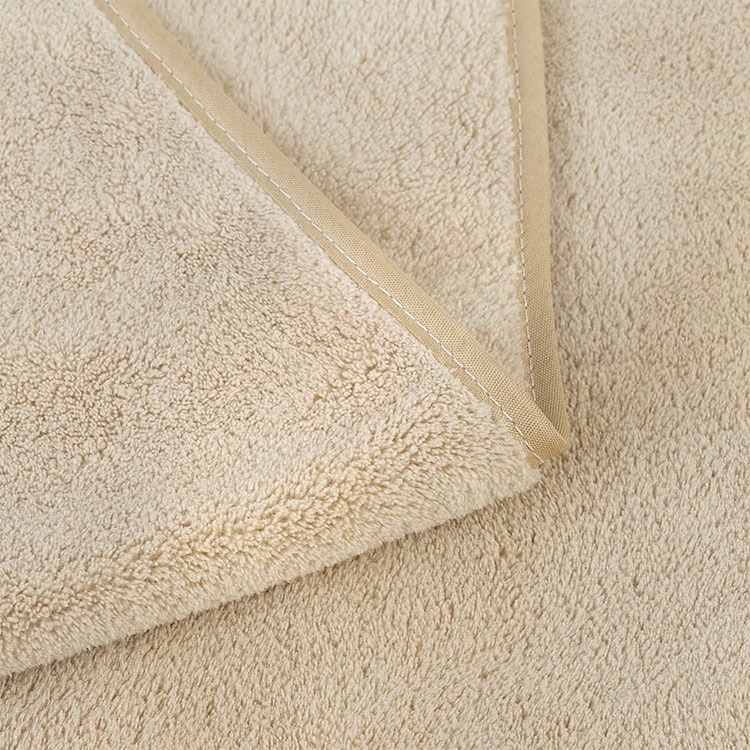
A cheap border can ruin an otherwise decent towel because surface contact happens at the perimeter more often than sales decks admit, especially in automotive, glass, screen, and finished-surface work where dragging a stiff stitched edge across trim or gloss surfaces is asking for complaints.
For paint-safe or finish-sensitive categories, I would absolutely consider edgeless microfiber towels. The site already positions them around professional wipe-downs, buffing, and touch-ups, which is the right use case. For lower-risk janitorial or industrial programs, standard stitched edges may still win on cost and durability.
5. Size tolerance and finished weight tolerance
A 40×40 cm towel that lands at 37×38 cm after finishing and washing is not a rounding error. It is a different product.
Confirm:
cut size
finished size
wash-shrink expectation
per-piece weight tolerance
carton net/gross weight tolerance
I want numbers, not adjectives. ±2 cm. ±5% weight. Something measurable. Without that, reorder consistency is fiction.
6. Split quality and actual absorbency behavior
This is the part the prettier samples hide.
Microfiber performance depends on fiber splitting and finishing, not just composition. A towel can technically be microfiber and still underperform if it is badly processed, poorly finished, or built to hit price instead of function. I care less about hearing “Korean style” or “premium export grade” and more about seeing whether the towel actually pulls water, picks up residue, releases cleanly, and keeps doing it after repeated laundering.
Ask for a sample test protocol:
dry weight
wet pickup
drying time between cycles
residue release after wash
before/after photos if the use case is detailing or glass
7. Lint profile and streak risk
If you sell into glass, mirrors, chrome, screens, optics, or polished coatings, lint is not a minor annoyance. It is the complaint.
This is why I like using internal anchors such as microfiber glass cloths and waffle weave microfiber towels inside this article. They match the real buying intent behind “streak-free” far better than a generic product hub page does. The site’s glass-cloth and waffle clusters already separate those lint-sensitive jobs from broader cleaning use, which is exactly what a serious buyer should do too.
My rule is simple: if the supplier cannot tell you what they consider acceptable linting after laundering, they have not built the product for a demanding end user.
8. Colorfastness, dye bleed, and white-towel contamination risk
Nobody talks about this enough.
Bulk microfiber towels often get washed in mixed commercial loads. Dark towels bleeding into lighter towels, coatings, salon stock, hospitality stock, or white janitorial inventory is one of those stupidly avoidable losses that makes everybody angry because the product looked fine on arrival.
Confirm:
colorfastness testing
whether dark colors were tested against white loads
bleach sensitivity
recommended detergent chemistry
first-wash instructions
And yes, I would get this in writing before the PO.
A towel that feels excellent on day one but loses shape, twists, hardens, or drops performance after 15 commercial cycles is not cheap. It is expensive inventory disguised as a bargain. That is why the site’s customization page gets one thing right: after sample approval, it says the production spec should lock material, GSM, stitching/edge, logo method, and packaging standard for reorder stability. That is grown-up sourcing.
I would ask for:
wash-cycle benchmark used
recommended commercial wash temp
shrinkage percentage after set cycles
edge failure rate
whether fabric hand-feel changes materially after repeated drying
10. Packaging format, carton logic, and barcode discipline
This one gets ignored until the warehouse starts swearing.
Given the 2024 freight shock, buyers should stop treating packaging as decoration and start treating it as logistics engineering. Inner packs, master-carton counts, carton dimensions, barcode placement, polybag thickness, insert requirements, and mixed-SKU feasibility all change landed cost and warehouse labor. Reuters’ 2024 shipping coverage is the reminder: when rates spike, dead air in the carton becomes a tax you chose to pay.
If you are doing private label, route the reader naturally to custom OEM microfiber towel programs. That page is one of the strongest conversion assets on the site because it speaks the language buyers actually use: labels, hangtags, inserts, MOQ, QC, and repeat-order stability.
11. Compliance file: fiber declaration, test support, market documents
Paper first.
I know some suppliers hate this part because it slows the romance of the quote, but I would rather kill a deal in week one than discover in month three that the seller has no clean fiber declaration, no test support, no packaging conformity trail, and no idea how to answer a buyer asking for REACH support, OEKO-TEX alignment, or third-party colorfastness reporting.
The site’s customization and product inquiry flows explicitly mention ISO 9001-aligned QC, REACH compliance support, OEKO-TEX, GRS for RPET, and documentation for USA/EU programs. That language should not sit on a page as decoration; it should become your RFQ checklist.
And remember the ugly part: customs and sourcing enforcement got harder, not softer, in 2024. That Reuters UFLPA reporting is why I would verify origin and declarations early, especially if any “cotton blend,” “cotton backing,” or mixed-fiber accessory is involved.
12. Reorder lock: sample code, mill code, and version control
This is the killer spec. The one most buyers miss.
A supplier may send you a strong pre-production sample, then run mass production with a near match rather than a true match unless the approved version is locked to a production code, fabric code, color code, GSM tolerance, edge method, and packaging revision. I have seen more margin get vaporized here than on headline unit cost.
So I want:
approved sample ID
fabric code
color code or Pantone reference
edge method code
packaging revision number
signed reorder spec sheet
No lock, no confidence. It really is that simple.
My blunt framework for how to choose wholesale microfiber towels
Most buyers asking how to choose wholesale microfiber towels are really asking a more honest question: “How do I avoid getting stuck with 20,000 units of almost-right stock?” My answer is not glamorous.
And here is the harder truth. The best wholesale microfiber towels are usually boring. They are not the loudest sample, the fluffiest hand-feel, or the cheapest FOB quote. They are the towels that reorder cleanly, survive the wash, fit the task, and arrive in the same form six months later when the buyer has stopped paying close attention.
FAQs
What is the best microfiber towel GSM for wholesale buying?
The best microfiber towel GSM for wholesale buying is the weight range that matches the end use, with roughly 200-280 GSM for glass and low-lint work, 250-350 GSM for all-purpose cleaning, 320-420 GSM for buffing, and 450-900+ GSM for drying because GSM changes absorbency, drag, drying speed, carton cost, and wash behavior together.
I would never approve GSM in isolation. Pair it with weave, blend, edge, and wash-cycle testing.
Are 80/20 microfiber towels better than 70/30 microfiber towels?
80/20 microfiber towels are usually better for broad commercial volume because they balance cost, absorbency, and scalability, while 70/30 microfiber towels are usually better for softer hand-feel, more delicate surface work, and premium positioning, which means the better choice depends on task risk, not on internet bragging rights.
If you sell to detailers, optics, or premium retail, 70/30 may earn its keep. For mainstream bulk programs, 80/20 often wins the math.
When should I buy edgeless microfiber towels?
Edgeless microfiber towels are the better option when the surface is sensitive enough that a stitched border could increase the risk of marring, drag, or complaint rates, especially in automotive finishing, polished surfaces, screens, coated panels, and other categories where perimeter contact matters as much as pile softness.
For janitorial, industrial, or lower-risk cleaning, stitched edges may still be the smarter commercial call.
What documents should I request before placing a bulk microfiber towel order?
The documents to request before placing a bulk microfiber towel order are a fiber-content declaration, product spec sheet, approved sample reference, color and size tolerances, wash-care guidance, test support for colorfastness or shrinkage where relevant, and any market-facing compliance paperwork needed for your destination such as REACH-related support or third-party safety labels.
I would also request packaging specs and carton details. Freight volatility made that non-negotiable in 2024.
How do I evaluate microfiber cleaning cloth bulk suppliers without wasting money on bad samples?
The right way to evaluate microfiber cleaning cloth bulk suppliers is to run a controlled sampling process that compares blend, GSM, weave, edge finish, linting, absorbency, drying time, wash-cycle survival, and packaging accuracy against a written approval sheet, because buying by hand-feel alone almost guarantees that mass production will drift from the sample.
Three samples beat one. One approved code beats ten promises.
Microfiber towel manufacturer & factory for custom, OEM, and private label programs. Focused on repeatable B2B supply for USA & EU markets (plus selected Asian countries).