
卸売り マイクロファイバータオル バルク
工場見積もりはお早めに
あなたのスペックを教えてください。私たちのチームは、推奨される 織り、GSM、サイズ、包装.
カスタム/OEM/プライベートラベルマイクロファイバータオル
ワンストップ製造 - 品質管理 - 輸出対応供給
🔒 SSL暗号化 - お客様の情報は、お客様のリクエストにお応えするためにのみ使用されます。.
This is the hard-nosed guide resort buyers actually need: why printed microfiber beach towels outperform bloated cotton programs in many retail settings, where suppliers hide risk, what U.S. labeling law really demands, and how to build a towel assortment that sells, photographs, and reorders.
Margins matter first. I have watched too many hospitality buyers treat towels like a housekeeping line item when the smarter comparison is branded merchandise, because the moment a guest picks one up in a resort shop they are not buying absorbency alone, they are buying memory, portability, logo visibility, and a small piece of the property’s identity. Why do so many teams still source beach towels as if they were back-of-house linen?
That is not theory. In a 2019 Boston Hospitality Review study on hotel amenity use, gift shops were listed among the most-used resort amenities, and Washington’s Department of Revenue explicitly treats gift shop sales as retail services common to lodging businesses, which is exactly how operators should think about them: revenue-generating retail, not decorative afterthoughts.
And the category has drifted upward. Bloomberg reported in July 2025 that the Four Seasons San Domenico Palace was selling Dolce & Gabbana-branded lounge liners for about €559, or roughly $656, which tells me something brutally simple: at the top end of hospitality, textile merch has already crossed over from utility into visible status signaling. So why would a resort shop settle for generic hotel beach towels that look like liquidation stock?
The travel backdrop makes this even more unforgiving. WTTC said in May 2025 that the U.S. was on track to lose $12.5 billion in international visitor spending, and Reuters noted foreign-traveler spending in 2024 still represented about $215 billion, or 0.7% of U.S. GDP, which means every in-property retail category has to work harder per guest, not merely exist. I do not think resort retail has room anymore for bulky, visually dull towel inventory that eats freight and bores shoppers on the shelf.

Print sells faster. A printed microfiber beach towel gives retailers something cotton often struggles to deliver at the same efficiency level: loud color, lower bulk, easier packing, and a cleaner story for guests who want something that fits in a tote instead of monopolizing a suitcase. Isn’t that the real retail test?
Your own site architecture already points in the right direction. The category hub for microfiber beach towels sends buyers into three commercial directions that actually make sense for resort retail: printed beach towels with full-color OEM supply, quick-dry microfiber beach towels wholesale, そして round microfiber beach towels custom design. That is not random catalog sprawl; it maps neatly to three buying motives—graphic impact, practical use, and statement-piece merchandising.
Dry time matters. When guests move from pool deck to room, then from room to excursion boat or beach transfer, the towel that dries faster and packs smaller has a retail advantage that plush cotton cannot fake, especially in fly-in resort markets where baggage friction shapes impulse buying more than many buyers admit. Why push a product that feels luxurious on a fixture but becomes annoying the minute it has to travel?
について quick-dry microfiber beach towels wholesale page is already positioned for that reality, tying the product directly to resort gift shops, bulk programs, packaging flexibility, and sample evaluation before scale. I would lean into that harder in the article body and treat quick-dry behavior as a retail outcome, not a technical footnote. Guests do not buy “fabric structure”; they buy “less wet, less bulky, easier tomorrow.”
Bad printing kills trust. I have seen beautiful resort artwork turn muddy because the supplier nailed the mockup and fumbled the production discipline, which is the part factories love to hide behind vague phrases like “OEM support” while hoping the buyer never asks about proofing, wash stability, edge finishing, or lot-to-lot consistency. Why pretend the artwork file is the hard part?
The stronger move is to route readers toward custom microfiber towels OEM and private label only after they understand the product choice, because that page speaks the language procurement teams need: proofing, sampling, private label packaging, and repeat-order control for USA and EU buyers. For resort retail shops, that matters more than any mockup gallery. A towel that photographs well but reorders badly is not a hero SKU; it is a return problem waiting for high season.
Labels are legal. The ugliest mistake in this category is not choosing the wrong pattern; it is shipping a towel into a retail channel without the right fiber, origin, and responsible-party disclosures, then acting surprised when a buyer, customs team, or marketplace flags it. How many “premium” towel suppliers still treat labeling like optional decoration?
について FTC’s textile guidance is blunt: textile products generally need fiber content, country of origin, and the identity of the manufacturer or another responsible company, and for towels and other flat goods, Customs requires origin disclosure that identifies where the fabric was made; the FTC also says internet or catalog advertising must disclose origin consistently with the physical label. That is not copywriting fluff. That is baseline market-entry discipline.
And then there is the sustainability trap. NOAA’s 2023 Marine Microplastics Primer says microfibers from textile washing account for about 35% of microplastics in aquatic systems, which means any resort retailer using microfiber should stop pretending the conversation ends at “quick-dry” and start thinking in terms of care instructions, wash-life, claims restraint, and whether recycled options are being documented instead of merely marketed. Isn’t that what serious procurement looks like now?
I would also stop letting suppliers get away with vague compliance language. Your 工場ページ talks about AQL-style acceptance sampling, REACH restriction considerations, and support for documentation requests such as OEKO-TEX and GRS where applicable; your applications page pushes third-party test reports, colorfastness, dimensional stability, batch COA, and lot traceability. Good. Put that front and center. Resort retail buyers do not need romance; they need evidence.
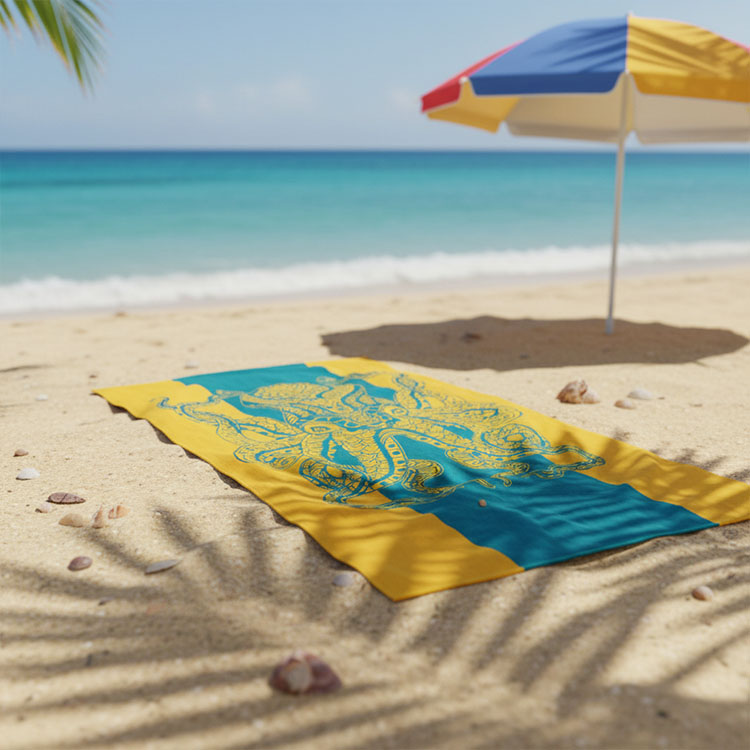
Start narrower. The worst assortment strategy is the one I see constantly: six mediocre SKUs, weak packaging, no meaningful proof hierarchy, and no distinction between souvenir towel, premium logo towel, and social-first showpiece. Why not build the line around actual shopper behavior instead of supplier convenience?
Here is the framework I would use for printed microfiber beach towels in resort retail shops:
| Decision Point | What I would demand from the supplier | Why it changes sell-through |
|---|---|---|
| Core assortment | One fast-moving rectangular printed SKU, one quick-dry utility SKU, one statement SKU | Keeps the fixture readable and reduces choice paralysis |
| Artwork control | Pre-production strike-off, color approval, wash test on sample | Prevents beautiful mockups from becoming ugly bulk stock |
| Retail packaging | Hangtag or pouch with care, size, fiber, and brand story | Turns a towel into a giftable purchase instead of a folded commodity |
| コンプライアンス・ファイル | Fiber/origin/responsible-party label draft, country-of-origin listing, test-report availability | Cuts onboarding friction for procurement, wholesale, and retail teams |
| Reorder discipline | Locked specs for size, GSM, edging, print placement, and carton marks | Protects the second order, which is where profit lives |
| Merchandising logic | Differentiate “packable,” “giftable,” and “statement” towel roles | Helps shoppers self-select faster |
That is why I would keep the internal journey tight. From this article, readers should naturally move into the printed beach towels full-color OEM supply page when they are sold on brand impact, into quick-dry microfiber beach towels wholesale when they care about practical guest use, into round microfiber beach towels custom design when they want a louder visual SKU, and then into カスタムパッケージングセット または custom microfiber towels OEM and private label when they are ready to specify the commercial details. That is a buying sequence. It is also a better SEO-to-conversion sequence.
And I would make one more unpopular call. If the resort is premium enough to sell affiliation, not just function, the towel should not be treated as a generic amenity duplicate. It should be treated like branded merchandise with its own margin target, packaging logic, and photography standard. Otherwise, why bother printing it at all?
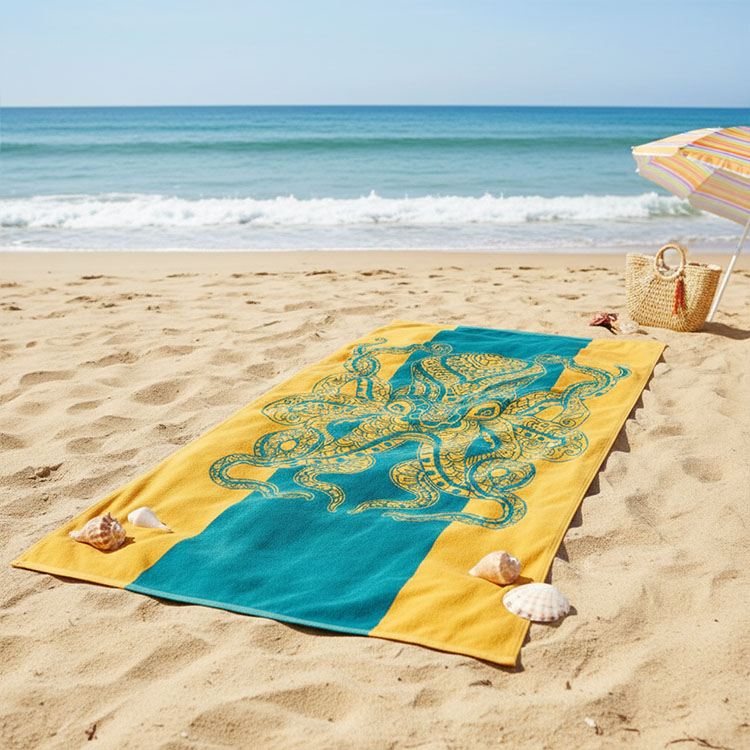
Printed microfiber beach towels for resort retail shops are lightweight, synthetic, logo-ready towels built to dry faster, display brighter artwork, and pack more easily than bulky terry options, which makes them well suited to gift shops, poolside merchandising, branded promotions, and private-label souvenir programs.
That is why the most useful product pages on this site are the microfiber beach towels collection, printed beach towels full-color OEM supply, そして quick-dry microfiber beach towels wholesale pages, because they separate graphic-first, utility-first, and assortment-first intent instead of dumping every buyer into one generic SKU bucket.
Custom printed beach towels are better for resort gift shops when the priority is vivid graphics, travel-friendly bulk, and faster post-swim dry-down; cotton still wins on plush hand-feel, but microfiber usually wins on packing convenience, freight efficiency, and visible brand storytelling at the shelf.
I would not frame it as a religion. I would frame it as channel fit. Resort shops sell to guests who travel, impulse-buy, and photograph what they buy. That behavior is closer to merch than linen replacement, which is exactly why printed microfiber keeps outperforming the old plush playbook in many resort settings. Bloomberg’s reporting on luxury hotel merchandise makes that shift hard to ignore.
Hotel beach towels sold in the U.S. must generally disclose fiber content, country of origin, and the identity of the responsible company or its RN, and towels as flat goods face added origin-detail expectations that must also match how the item is described in online or catalog advertising.
This is the part too many suppliers soft-pedal. The FTC textile guidance is not optional reading if you are importing, private labeling, or retailing resort beach towels in the U.S. market.
The best way to reduce returns on personalized microfiber beach towels is to lock the pre-production sample, wash-test the printed surface, verify colorfastness and dimensional stability, confirm legal labeling, and pair the towel with packaging that explains care, use case, and size before the guest reaches checkout.
Your applications page already hints at the right evidence stack—third-party testing, colorfastness, shrinkage, batch consistency, lot traceability, and documentation for USA/EU programs. That is the conversation resort buyers should be having before they approve bulk production.
Wholesale microfiber beach towels can be a sustainability risk when brands sell quick-dry performance without discussing wash shedding, care instructions, recycled-material documentation, or claim accuracy, because microfiber pollution is part of the product story whether retailers acknowledge it publicly or not.
NOAA says microfibers from textile washing account for about 35% of microplastics in aquatic systems, so I would be very careful with lazy eco-language and much more serious about documented recycled programs, care guidance, and restrained environmental claims.
Pick three SKUs only. Then force every supplier conversation through the same adult filter: sample proof, print stability, legal label draft, packaging option, and reorder discipline. Why keep pretending the towel business is soft and simple when the margin leaks come from hard operational sloppiness?
If you want this page to pull buyers toward inquiry instead of passive reading, keep the flow commercial and tight: introduce the problem, prove that resort retail is real retail, explain why printed microfiber beach towels work, expose the compliance traps, and then send readers to the pages that close intent—printed beach towels full-color OEM supply, quick-dry microfiber beach towels wholesale, round microfiber beach towels custom design, カスタムパッケージングセット, custom microfiber towels OEM and private label, そして 工場品質管理ページ. That is the route from traffic to RFQ. Not pretty. Just effective.
マイクロファイバータオルの製造・販売。米国およびEU市場(および特定のアジア諸国)向けの反復可能なB2B供給に重点を置いています。.
